This post was written by Lily York, an Environmental Sociology and Political Science major at Vanderbilt University. It was originally published on January 12, 2026 on the McGee Applied Research Center for Narrative Studies website. The McGee Center aims to equip individuals with the essential skills and knowledge required to adeptly navigate and critically assess narratives in the dynamic media landscape of the 21st century. Through innovative research endeavors, collaborative educational initiatives, and active engagement with the community, the McGee Center is helping build a future where media literacy becomes a cornerstone for informed and empowered citizenship.
Each night, network news reaches millions of Americans. Even as skepticism toward the media grows, television news continues to influence what people perceive as important, urgent, and controversial. Climate change is one of the most prominent and politicized issues in modern public discourse, and network coverage plays a significant role in shaping how audiences understand it. Media influence, it turns out, operates even when audiences are distrustful. The issues covered on nightly news often help set public priorities, so I wanted to ask: How has coverage of climate change evolved over time, and how do different networks frame the issue today?
To explore this question, I used Vanderbilt University’s Television News Archive (TVNA), an extraordinary resource that has recorded every national network evening news broadcast since August 1968, plus an hour of evening CNN since 1995, Fox News (2004), and MSNBC (2024, not included in this analysis). This archive made it possible to examine climate change coverage from the very beginning of its appearance in the news. I generated a list of climate-related keywords and searched the archive for every possible segment that referenced the issue. That search identified 4,361 news transcripts—4,361 moments in which climate change entered the national television conversation over the past five decades.
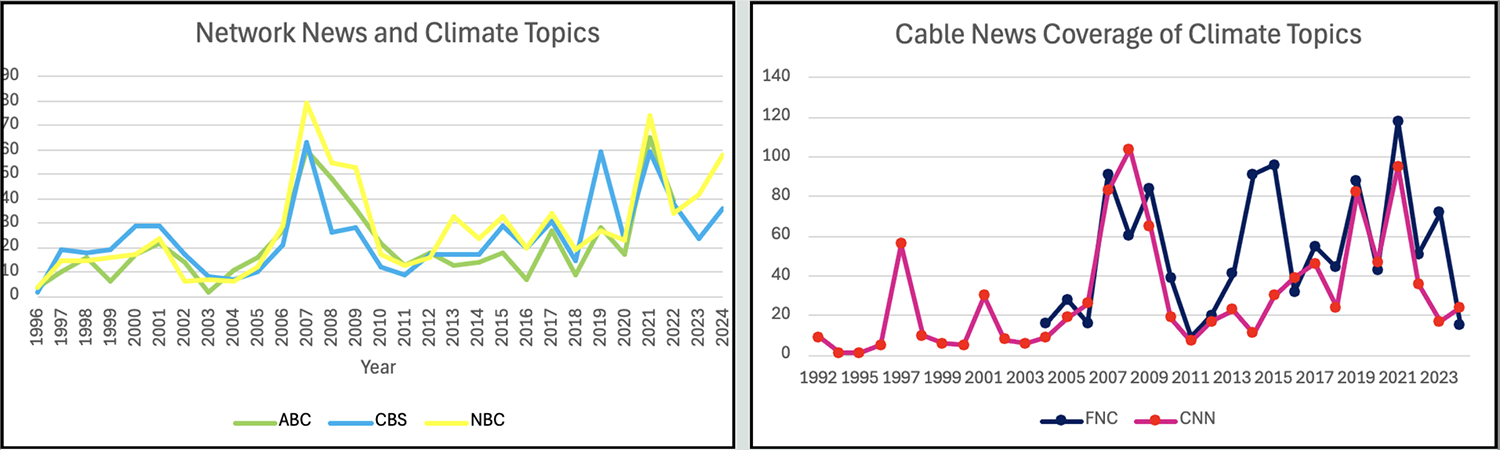
Looking at this data revealed clear patterns. Climate coverage has increased significantly over time, growing by roughly five additional stories per year since 1968. However, attention has not grown evenly. Instead, coverage rises sharply during moments of heightened public salience. One of the most striking spikes occurred in 2007, a year that appears to mark a turning point in public awareness. Notably, 2007 also marks the moment when the phrase “climate change” overtook “global warming” in news coverage, reflecting an evolving understanding of the issue that the media itself mirrored.
That same period also highlights the power of individual communicators and cultural moments. During 2007–2008, a substantial portion of climate-related coverage referenced Vice President Al Gore, following the release of his Oscar-winning documentary, An Inconvenient Truth. While that surge in attention was temporary, it demonstrates how influential figures and cultural events can elevate climate change on the national agenda.
Beyond trends over time, climate coverage also differs sharply by network. Fox News, despite beginning nightly broadcasts later than the other major networks, aired the highest total number of climate-related stories. However, about 35% of Fox’s coverage was framed skeptically or critically, compared to roughly 12% across other networks. Further, Fox News most often covered climate change in response to political events. In contrast, ABC, CBS, NBC, and CNN more frequently linked climate coverage to environmental disasters or scientific developments. Such differences help explain why Americans can encounter fundamentally different versions of climate change depending on where they get their news.

Using the TVNA, I was able to paint a long-term picture of how one of the most consequential and contested issues of our time has been presented to the public. Television news does not simply report climate change; it frames it. Over time, this framing shapes what audiences understand, what they question, and what they prioritize.